
 By Dennis Weche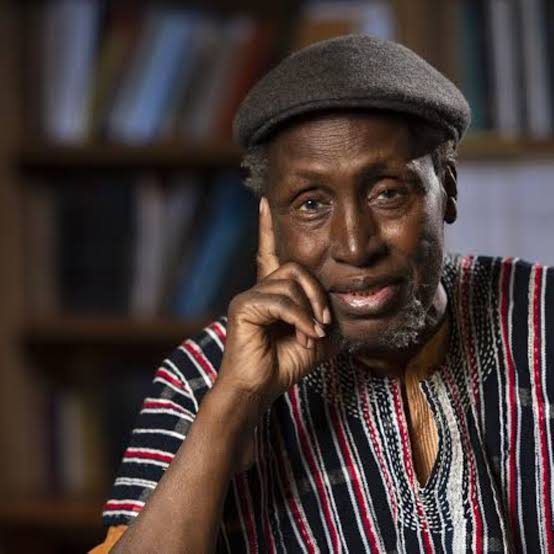
When the world received news that Prof. Ngũgĩ wa Thiong’o had taken his final bow, it felt less like a headline and more like a seismic shift in African letters. His passing did not arrive as a mere notification. It reverberated across lecture halls, libraries, and the hearts of those who had truly read him. A continent paused, if only for a moment, to acknowledge that one of its loudest literary voices had fallen silent.
That morning, I wandered to a familiar street vendor’s stall, drawn not by habit but by the silent pull of reverence. There, laid out among the usual clutter, was a national daily, and on its cover loomed a striking portrait of the late Prof. Ngũgĩ. His expression, calm yet unyielding, stared out as if still questioning, still challenging, still writing. The brief biography beside the image pulled passersby closer, many of them unsure whether they were mourning a man or simply trying to recall a name from school.
I purchased a copy and made my way to Bukhungu Stadium, my usual place of work, where I sat and began to read. Article after article attempted to frame the enormity of Ngũgĩ’s legacy: a novelist, a playwright, a political detainee, a father of language decolonisation, an intellectual who dared to reject English as the sole medium of African expression.
As I sat immersed in these reflections, a colleague approached and glanced at the newspaper.
“You still buy newspapers?” she asked, amused.
I smiled and turned the front page toward her.
Her eyes caught the photograph. She stared a little longer than I expected.
“Is that… Ngũgĩ wa Thiong’o?” she asked.
“Yes, it is.”
She nodded slowly. “I read The River Between in high school. It was on the KCSE list.”
“What do you remember from it?” I asked.
She looked away for a second, then said, “Nothing much. That was back in 2012. Honestly, we read it just to pass.”
Her response, though casual, cut deep. It crystallized a truth many of us in education circles know but rarely confront: most learners are not reading to understand, to feel, or to grow. They are reading to comply. They are reading to survive the exam system. And in doing so, they are not really reading at all.
What would Ngũgĩ himself have said?
This was a man who refused to write in English, not out of rebellion for its own sake, but out of a profound belief that language is inseparable from identity and history. He believed that African literature, to be fully authentic, must root itself in African tongues, worldviews, and struggles. His Gikuyu language play Ngaahika Ndeenda led to his imprisonment, and yet he never wavered.
And now, in classrooms across the country, his work is remembered not for its revolutionary message, but for its role as an exam text. His characters are not companions; they are case studies. His metaphors are not marvelled at; they are dissected for marks. Learners skip the original books in favor of guidebooks and digests. Teachers, pressed by unrealistic timelines, often focus on testable content rather than thematic depth.
Ngũgĩ did not write for exams. He wrote for awakening. His literature wrestled with colonialism, with memory, with language, with identity. He asked uncomfortable questions: Who are we? What language do we dream in? Whose memory do we carry? To engage Ngũgĩ’s work was to walk into a mirror and be forced to look at yourself.
But if our learners are only reading to pass, when do they ever pause to look?
This moment, then, should be more than a time of mourning. It should be a time of reckoning. What kind of readers are we producing? What kind of citizens? Are we teaching literature or merely teaching exams?
There is still time to return to the soul of the written word. Let us teach books as living things, not just syllabuses. Let us allow our students to dwell in the world of a novel before we ask them to analyze it. Let us invite them to feel before they interpret.
As we honour Ngũgĩ wa Thiong’o’s legacy, let us not reduce him to a high school memory. Let us read him again, outside the frame of exams, outside the tyranny of points, outside the four corners of a test booklet. Let us read him the way he would have wanted to be read: as a witness to truth, a warrior for language, and a lover of story.
For though his voice has stilled, his words remain. And they are waiting, not just to be studied, but to be heard.
Facebook Comments